This page was generated from the Jupyter notebook
compare_model_potentials.ipynb.
Compare different effective model potentials
[1]:
import matplotlib.pyplot as plt

import rydstate
Check Rubidium with large n
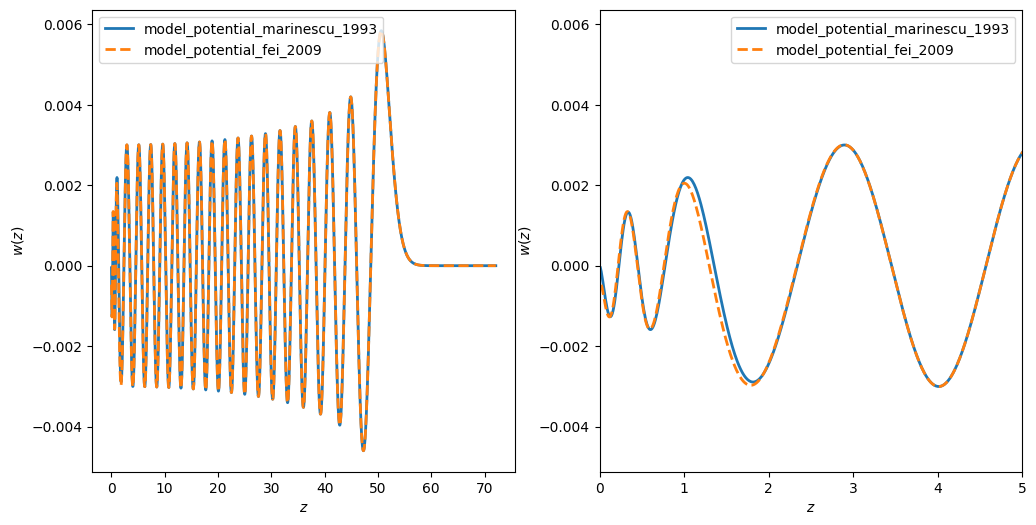
For Rubidium and large quantum numbers n we expect the effective model potentials to be very similar.
[ ]:
species, n, l, j = "Rb", 40, 0, 0.5
state = rydstate.RydbergStateSQDTAlkali(species, n, l=l, j=j)

states: dict[str, rydstate.RydbergStateSQDTAlkali] = {}
states["marinescu_1994"] = rydstate.RydbergStateSQDTAlkali(species, n, l=l, j=j, potential_class="marinescu_1994")
states["fei_2009"] = rydstate.RydbergStateSQDTAlkali(species, n, l=l, j=j, potential_class="fei_2009")

for label, state in states.items():
    print(f"Integrating wavefunction for {label}")
    state.radial.integrate_wavefunction()
Integrating wavefunction for marinescu_1994
Integrating wavefunction for fei_2009
[3]:
fig, axs = plt.subplots(1, 2, figsize=(12, 6))

for ax in axs:
    linestyles = ["-", "--", "-.", ":"]
    for label, state in states.items():
        ax.plot(state.radial.z_list, state.radial.w_list, label=label, lw=2, ls=linestyles.pop(0))

    ax.legend()
    ax.set_xlabel("$z$")
    ax.set_ylabel("$w(z)$")

axs[1].set_xlim(0, 5)

plt.show()